Sunday, May 21
Today we visited Derry in Northern Ireland. There was an excellent museum on the Troubles and we learned even more. I apologize if this feels really heavy, but this country’s history is pretty heavy. Basically, Janet and I have concluded it all started as another example of colonization, where England wanted the Irish land and basically came and took it. They outlawed the Irish religion, language, and culture, and discriminated against the people because they had the power to do so.
The English did something similar in the US and we successfully revolted. But unfortunately, we learned from the English and did the same thing to the indigenous people of North America and later the Black people whom we kidnapped from their land and forced into slavery. It is another story of the powerful taking what they want and insuring that the minority never regains power. The majority is taught that the minority people are bad and to fear them and never let them get any power. What awful things we humans repeatedly do to each other. The Irish have fought back and continue to do so. But so much violence.
We toured the Catholic neighborhood in Derry where we saw murals glorifying those involved in the violence similar to what we saw yesterday in the Protestant neighborhoods of Belfast. It happens on both sides.
Derry was the site of Bloody Sunday on Jan. 30, 1972 when, on the fringe of a peaceful civil rights march, a few young people rioted. The British army was called in and by the time it was all over the army had killed 13 protestors. If you are a U2 and Bono music fan (Bono is an Irish rock musician and a Christian) you might know his song, Sunday, Bloody Sunday. If not, and you want to rock out, listen to it here on YouTube. This mural was in honor of those killed on Bloody Sunday and the second photo is a memorial to Bloody Sunday.

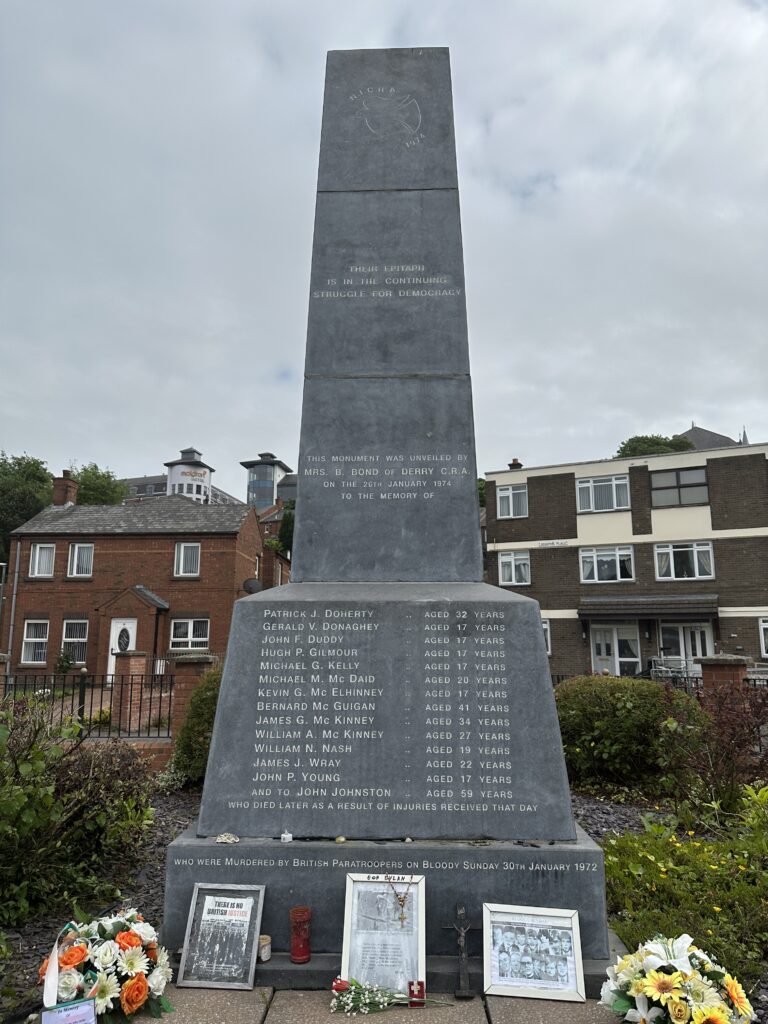
Those on both sides of the conflict glorify the violence and see all who die as martyrs.


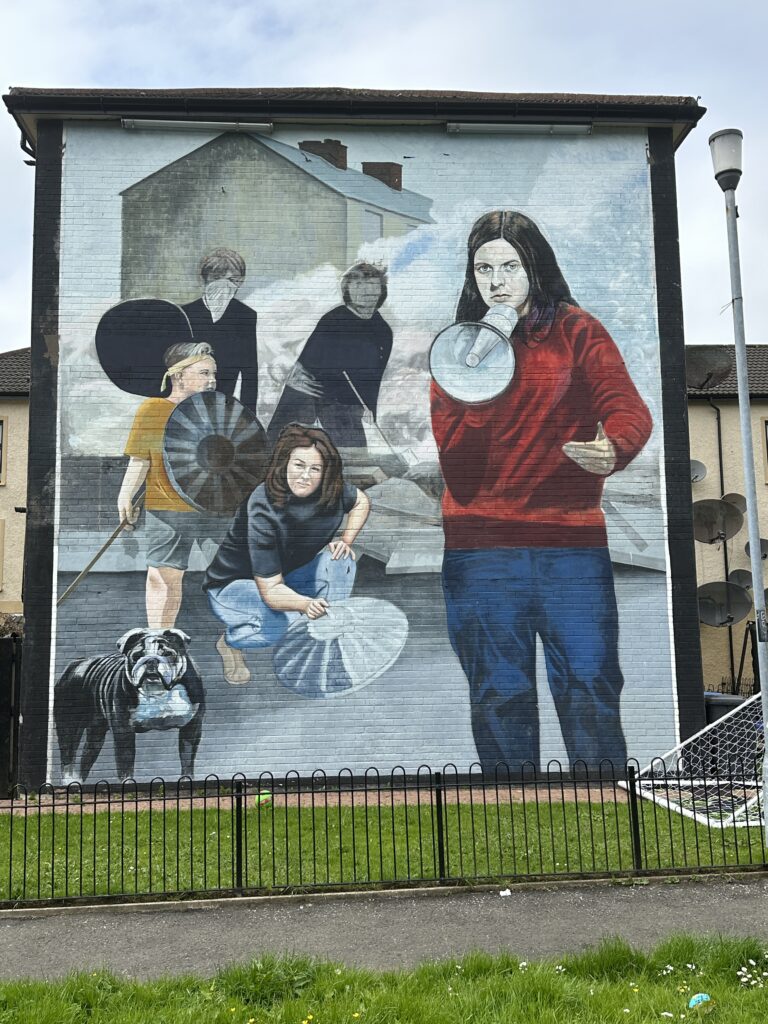
The mural below honors Bernadette Devlin McAliskey, an outspoken civil rights leader, who, at 21, became the youngest elected member of the British parliament. The people banging trash can lids on the road was a way of warning neighbors of approaching British patrols.
We mentioned yesterday the support of the Catholic Nationalists for the Palestinians. Here is how Rick Steves describes the situation represented in the following mural. “Palestinians and Catholic residents of Northern Ireland have a special empathy for each other—both are indigenous people dealing with the persistent realities of sharing what they consider their rightful homeland with more powerful settlers planted there for political reasons.”

But there are also signs of hope. This is a peace dove with the oak leaf symbol of Derry in the background. The dove is rising from the dark blues of history to the lighter oranges and yellows of the future.

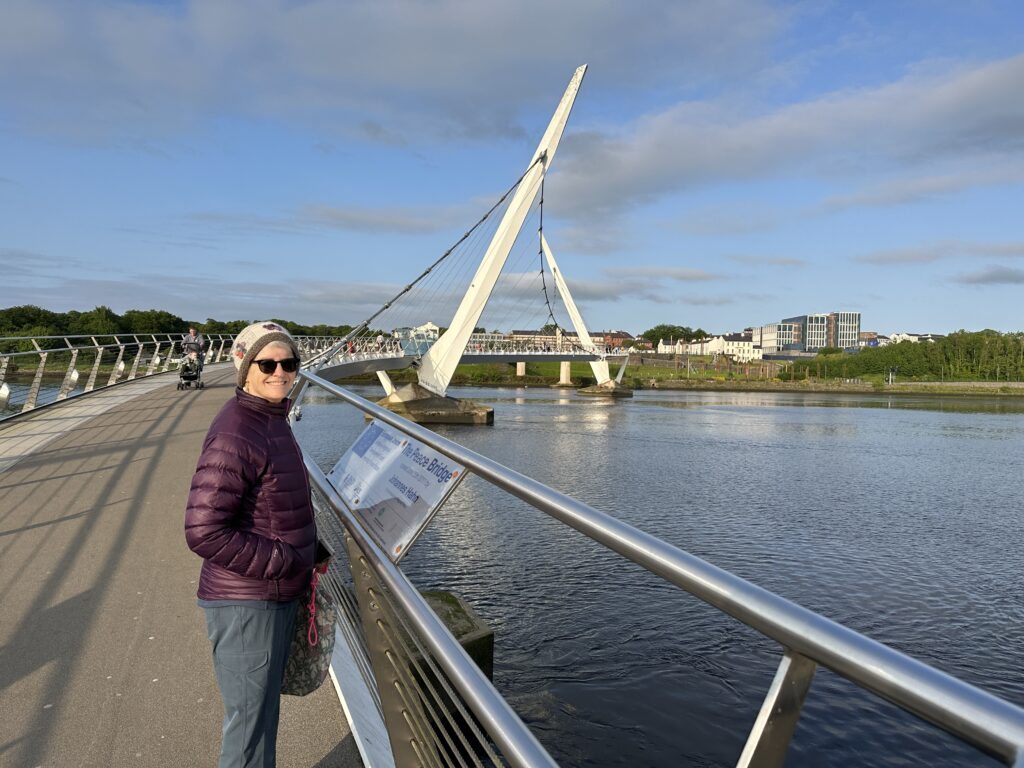
And here is the Peace Bridge which spans the River Foyle, running from the predominantly Catholic side to the predominantly Protestant side. It is built with curves in it. I don’t know the official symbolism, but for me it represents the long and winding road to peace.
Derry has an inspiring and hopeful statue called Hands Across the Divide.

So yes, we come away with some hope, but also many questions. Can we learn to first see, and then apologize, and repent, of the damage we have done when we have been the powerful? Can we provide reparation? Can we learn to live with our neighbors who seem different from us rather than running to our own tribe and building walls? Can we love our neighbor and stop killing others in the name of religion? Hard questions, but ones we must learn from.
Tomorrow we meet some of Janet’s cousins for a couple days of touring and joyful reunion.
God bless,
Coe


Can we learn to first see, and then apologize, and repent, of the damage we have done when we have been the powerful? Can we provide reparation? Can we learn to live with our neighbors who seem different from us rather than running to our own tribe and building walls? Can we love our neighbor and stop killing others in the name of religion? Have we ever learned from these atrocities? I think we have not and I don’t believe we will. They continue even as I type. Human nature is what it is and it has not changed in two thousand years. I’m leaning into acceptance.
I love the hands across the divide and the peace dove pictures.